Pediatric Neuropsychology Fellow Children's National Hospital Bayville, New Jersey, United States
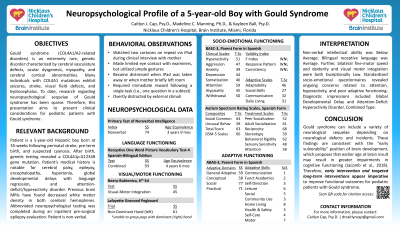
Objective: Gould syndrome (COL4A1/A2-related disorders) is an extremely rare, genetic disorder characterized by cerebral vasculature defects, ocular dysgenesis, myopathy, and cerebral cortical abnormalities. Many individuals with COL4A1 mutations exhibit seizures, stroke, visual field defects, and hydrocephalus. To date, research regarding neuropsychological sequelae of Gould syndrome has been sparse. Therefore, this presentation aims to present clinical considerations for pediatric patients with Gould syndrome.
Method: Patient is a 5-year-old Hispanic boy born at 35-weeks following perinatal stroke, pre-term birth, and suspected cyanosis. After birth, genetic testing revealed a COL4A1p.G1234R gene mutation (i.e., Gould syndrome). Patient’s medical history is also notable for cerebral palsy, epilepsy, encephalopathy, hypertonia, global developmental delays with language regression, and attention-deficit/hyperactivity disorder. Previous brain MRIs have found decreased white matter density in both cerebral hemispheres. Abbreviated neuropsychological testing was completed during an inpatient pre-surgical epilepsy evaluation. Patient was non-verbal.
Results: Non-verbal intellectual ability was Below Average (IQ=74). Receptive language was Average (SS=93). Further, bilateral fine-motor speed and dexterity and visual motor integration were Exceptionally Low. Standardized questionnaires revealed ongoing concerns related to attention, hyperactivity, and poor adaptive functioning. Diagnostic impressions included Global Developmental Delay.
Conclusion: Gould syndrome can include a variety of neurological sequelae depending on neurological defects and incidents. These findings are consistent with the “early vulnerability” position of brain development, which proposes that earlier age at brain insult may result in greater impairments in cognitive functioning (Jacomb et al., 2018). Therefore, early intervention and targeted long-term interventions appears imperative to improve function outcomes for pediatric patients with Gould syndrome.