Neuropsychology Student Atlanta Comprehensive Neuropsychology Smyrna, Georgia, United States
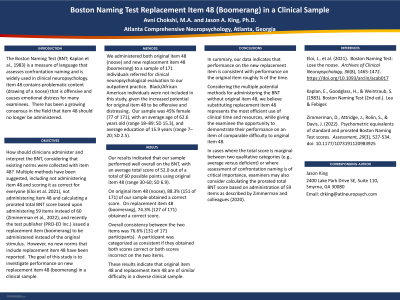
OBJECTIVE The Boston Naming Test (BNT) is a measure of language that assesses confrontation naming and is widely used in clinical neuropsychology. Item 48 contains problematic content (drawing of a noose) that is offensive and causes emotional distress for many examinees. How should clinicians administer and interpret the BNT, considering that existing norms were collected with item 48?
METHOD We administered both original item 48 (noose) and new replacement item 48 (boomerang) to a sample of 171 individuals referred for clinical neuropsychological evaluation to our outpatient practice. Our sample was 45% female (77 of 171), with an average age of 62.6 years old (range 18–89; SD 15.3), and average education of 15.9 years (range 7–20; SD 2.5).
RESULTS Our results indicated an overall consistency of 76.6% between the two items (131 of 171 participants). A participant was categorized as consistent if they obtained both scores correct or both scores incorrect on the two items. This result indicates that the original item 48 and replacement item 48 are of similar difficulty in a diverse clinical sample.
CONCLUSIONS In summary, our data indicates that performance on the new replacement item is consistent with performance on the original item roughly ¾ of the time. Considering the multiple potential methods for administering the BNT without original item 48, we believe substituting replacement item 48 represents the most efficient use of clinical time and resources, while giving the examinee the opportunity to demonstrate their performance on an item of comparable difficulty to original item 48.