Graduate Student William James College Middletown, Rhode Island, United States
Objective: In adult populations, performance validity indicators are well established, as they are efficient and can be a standalone to measure effort. There less known about the validity of effort testing with adolescents, especially when conducting neuropsychological evaluations on an inpatient unit.
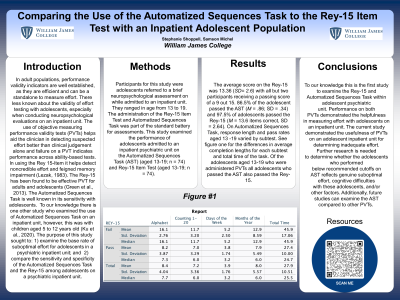
Method: This study examined the performance of adolescents admitted to an inpatient psychiatric unit on the Automatized Sequences Task (AST) (aged 13-19; n = 74) and Rey-15 Item Test (aged 13-19; n = 74).
Results: 86.5% of the adolescent passed the AST (M = .86; SD = .34) and 97.5% of adolescents passed the Rey-15 (M = 13.6 items correct, SD = 2.64). Conclusion(s): Performance on both PVTs demonstrated the helpfulness in measuring effort with adolescents on an inpatient unit. Further research is needed to determine whether the adolescents who performed below recommended cutoffs on AST reflects genuine suboptimal effort, cognitive difficulties with these adolescents, and/or other factors.