Graduate Student University of South Alabama Mendon, New York, United States
Objective: To examine the effects of traumatic brain injury (TBI) on identity functioning.
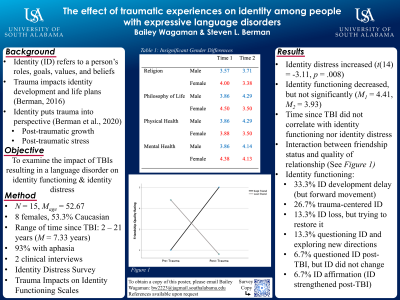
Method: TBI survivors’ recollections of their sense of identity before and after they acquired a TBI were compared. Participants (N = 15, Mage = 52.67) recruited from rehabilitation and support groups completed two clinical interviews, as well as the Trauma Impacts of Identity Functioning Scales (Waterman, 2020) and Identity Distress Scale (Berman et al., 2004). They were mostly stroke survivors with aphasia. The majority of the participants were White (53.3%). The time since they acquired an expressive language disorder ranged from 2 to 21 years ago (M = 7.33).
Results: A paired samples t-test revealed a significant increase in identity distress from pre- to post-brain injury (t(14) = -3.11, p = .008, 95% CI). A ONEWAY ANOVA revealed that ratings of how important their career is to their sense of identity significantly decreased post-TBI (F(1, 13) = 17.47, p = .001, λ = .427, 95% CI). During the clinical interviews, many TBI survivors reflected that they lost a large part of themselves because they could no longer pursue their careers, and they experienced drastic changes in their relationships and life roles. Participants had identity development delays, trauma-centered identity, identity loss, identity threat, and identity affirmation.
Conclusion: Identity changes post-TBI varied greatly from one survivor to another, and time since trauma was not significantly correlated with identity functioning nor identity distress, suggesting the need for future research to determine which factors influence why TBI survivors’ experience post traumatic identity disruption and/or post-traumatic growth.