Neuropsychology Postdoctoral Fellow Dartmouth-Hitchcock Medical Center/Geisel School of Medicine Lebanon, New Hampshire, United States
Objective: Explore popular assessments among psychologists from various specialties and variables impacting test selection.
Method: A survey designed by Rabin and colleagues (2016) was adapted with permission and administered via Qualtrics, taking 10-15 minutes to complete. Sampled individuals were licensed doctoral level psychologists living in the USA across multiple disciplines. School psychologists with master’s degree were also included. Non-parametric correlations were conducted to understand variables impacting test selection practices, particularly psychometrics (e.g., ecological validity, normative groups) and frequency of assessment.
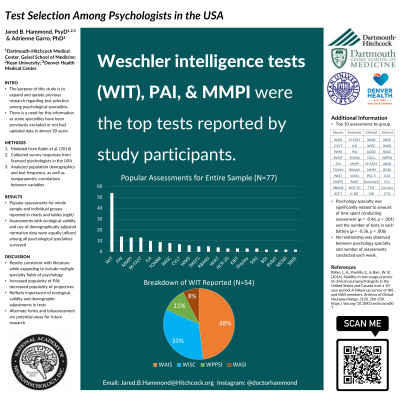
Results: Demographics of the 77 participants meeting study criteria are reviewed. The top three most popular assessments for all participants were: WAIS-IV (11.1%), WISC-V (8.7%), and PAI (6.8%). Popular assessments for the fields of neuropsychology, forensic, clinical and school psychology are reported. No significant relationships were found between psychology specialty and major psychometric variables tested. Psychology specialty was significantly related to time spent on assessment (𝝆 = -0.46, p < .001) and the number of tests in each battery (𝝆 = -0.36, p = .006). However, there was no relationship between psychology specialty and number of assessments conducted each week.
Conclusions: Wechsler intelligence tests continued as the most popular assessments among all sampled participants. PAI increased in popularity whereas projectives decreased in popularity. Results for individual psychology specialties remained relatively consistent with previous literature, except for forensic participants. All specialties reported similar likelihood of using assessments reflecting real-world outcomes and demographically representative normative data. Specialized fields of psychology may devote additional time to assessment and use longer batteries despite similar caseloads. Possible explanations are provided.