(275) Distinguishing Regional Cerebral Blood Flow between Posttraumatic Stress Disorder and Attention-Deficit/Hyperactivity Disorder in the Child Population
Psychology Trainee Nova Southeastern University Davie, Florida, United States
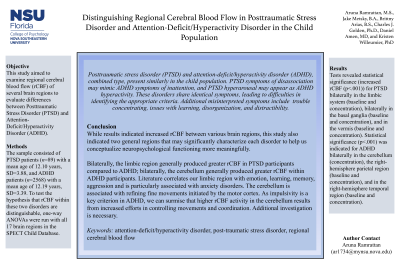
Objective. This study aimed to examine the regional cerebral blood flow (rCBF) of several brain regions to evaluate differences between Post-Traumatic Stress Disorder (PTSD) and Attention-Deficit/Hyperactivity Disorder (ADHD).
Method. The sample consisted of PTSD patients (n=89) with a mean age of 12.10 years, SD=3.88, and ADHD patients (n=2568) with a mean age of 12.19 years, SD=3.39. To test the hypothesis that rCBF within these two disorders are distinguishable, one-way ANOVAs were run with all 17 brain regions in the SPECT Child Database.
Results. Tests revealed statistical significance (increased rCBF (p <.001)) for PTSD bilaterally in the limbic system (baseline and concentration), bilaterally in the basal ganglia (baseline and concentration), and in the vermis (baseline and concentration). Statistical significance (p <.001) was indicated for ADHD bilaterally in the cerebellum (concentration), right-hemisphere parietal (baseline and concentration), and right-hemisphere temporal (baseline and concentration).
Conclusions. While results indicated increased rCBF between various brain regions, this study also indicated two general regions that may significantly characterize each disorder to help us conceptualize neuropsychological functioning more meaningfully. Bilaterally, the limbic region generally produced greater rCBF in PTSD participants compared to ADHD; bilaterally, the cerebellum generally produced greater rCBF within ADHD participants. Literature correlates our limbic region with emotion, learning, memory, aggression and is particularly associated with anxiety disorders. The cerebellum is associated with refining fine movements initiated by the motor cortex. As impulsivity is a key criterion in ADHD, we may surmise that higher rCBF activity in the cerebellum results from increased efforts in controlling movements and coordination. Additional investigation is necessary.