Graduate Student University of Texas at Tyler Tyler, Texas, United States
1.
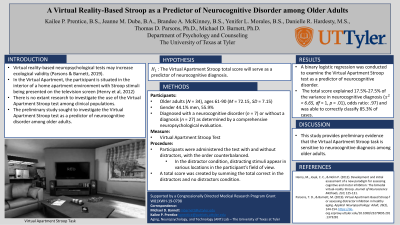
Objective: Virtual reality-based neuropsychological tests allow for immersive stimuli, which may increase ecological validity, and allows for the inclusion of standardized distractors. The Virtual Apartment Stroop test has demonstrated evidence of construct validity among healthy older adults, but no extant research has investigated its use among clinical populations. The purpose of this preliminary study was to investigate the Virtual Apartment Stroop test as a predictor of neurocognitive disorder among older adults.
2.
Method: The Virtual Apartment Stroop test was administered to older adults (n = 34; aged 61-90, M = 72.15, SD = 7.15; 44.1% men, 55.9% women) with (n = 7) or without (n = 27) a neurocognitive disorder as determined by a comprehensive neuropsychological evaluation. In the Virtual Apartment, the participant is situated in a home environment and Stroop test stimuli occur in single-item presentation on the television screen. Participants were administered the Virtual Apartment Stroop test both with and without distractors, with the order counterbalanced. In the distractor condition, distracting stimuli appear in various locations in the participant’s field of view.
3.
Results: A total score was created by summing the total correct in the distractors and no distractors conditions. Binary logistic regression found that this score explained 17.5-27.5% of the variance in neurocognitive diagnosis, (Χ2 = 6.56, df = 1, p = .01, odds ratio: 0.97) and the model was able to correctly classify 85.3% of cases.
4. Conclusion(s): These results provide preliminary evidence that the Virtual Apartment Stroop task is sensitive to neurocognitive diagnosis among older adults.