Student Nova Southeastern University Fort Lauderdale , Florida, United States
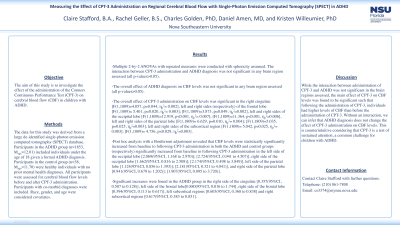
Objective: The aim of this study is to investigate the effect of the administration of the Conners Continuous Performance Test (CPT-3) on cerebral blood flow (CBF) in children with ADHD.
Methods: The data for this study was derived from a large - database. Participants in the ADHD group (n=1853, Mage=12.01) were similar to those in the healthy control group (n=38, Mage=11.70). All participants were assessed for cerebral blood flow levels before and after CPT-3 administration.
Results: Multiple 2-by-2 ANOVAs with repeated measures were conducted with sphericity assumed. The overall effect of CPT-3 administration on CBF levels was significant in the right cingulate left and right sides of the frontal lobe left and right sides of the occipital, left and right sides of the parietal lobe, left and right sides of the subcortical region. Post hoc analysis with a Bonferroni adjustment revealed that there was a statistically significant increase in CBF levels from baseline to following CPT-3 administration in both the ADHD and control groups. The interaction between CPT-3 administration and ADHD diagnosis was not significant. The overall effect of ADHD diagnosis on CBF levels was not significant.
Conclusions: All individuals had higher levels of CBF following the administration of CPT-3. Without an interaction, we can infer that ADHD diagnosis does not change the effect of CPT-3 administration on CBF levels. This is counterintuitive considering that CPT-3 is a test of sustained attention, a common challenge for children with ADHD. These findings need to be replicated.