Graduate Student Psy.D student at Loma Linda University Irvine, California, United States
Objective: The primary objective is to examine the main effects of Body Mass Index (BMI) and sleep quality on cognitive performance.
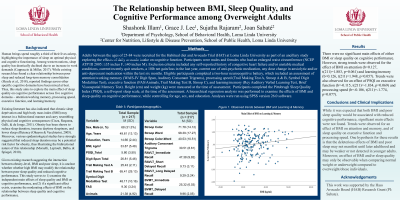
Method: Adults between the ages of 25-84 (n=217) were recruited for the Loma Linda University Healthy Avocado Trial study. Participants had a mean age of 49.61 (SD=13.13), mean education of 14.66 years (SD=2.44), and a mean BMI of 33.87 (SD=5.48). Sleep quality was measured using the Pittsburgh Sleep Quality Inventory (PSQI), and cognition was measured using a two-hour neurocognitive battery including tests of attention/working memory (WM), processing speed, executive function, and learning/memory. A hierarchical regression analysis was performed to examine the effects of BMI and sleep quality on cognitive performance, while controlling for age, sex, and education.
Results: There were no significant main effects of either BMI or sleep quality on cognitive performance. However, strong trends were observed for the effect of BMI on attention (b=0.127, t(211)=1.883, p=0.061) and learning/memory (b=0.126, t(211)=1.948, p=0.057). Trends were also observed for an effect of PSQI on executive function (b=-0.115, t(211)=-1.834, p=0.069) and processing speed (b=-0.106, t(211)=-1.774, p=0.077).
Conclusion(s): While it was expected that both BMI and poor sleep quality would be associated with reduced cognitive performance, significant main effects were not found. Trends were observed for an effect of BMI on attention and memory, and of sleep quality on executive function and processing speed. One hypothesis for these results is that the deleterious effects of BMI and poor sleep may not manifest until later adulthood and may be weaker or not detected in younger adults.