Psychology Trainee Nova Southeastern University Miami, Florida, United States
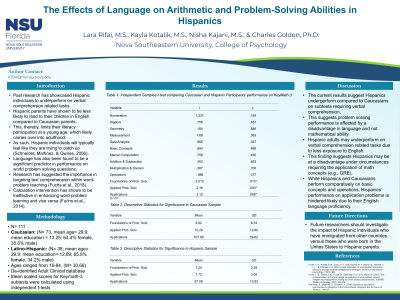
Objective: To identify differences between Hispanics and Caucasians in mathematics and problem-solving abilities using the KeyMath-3.
Methods: The data for this study was derived from a large de-identified database. The sample contained two groups: the Hispanic group, (n=38; 64.4% female; mean age=29.9, SD=10.46; mean education=12.89, SD=10.46) and the Caucasian group (n=72; 65.8% female; mean age=31, SD=13.27; mean education=13.25, SD=1.38). The mean scaled scores for the KeyMath-3 subtests were calculated using independent sample t-tests.
Results: Results showed no significant differences between Hispanics and Caucasians on Numeration, Algebra, Geometry, Measurement, Data Analysis, Basic Concepts, Mental Computation, Addition and Subtraction, or Multiplication and Division subtests. However, significant differences were found between the two groups on Foundations of Problem Solving [Caucasian M=9.92, SD=6.32; Hispanics M=7.23, SD=2.39; t(108)=6.913, p=.010] and Applied Problem Solving [Caucasian M=12.28, SD=12.8; Hispanics M=7.71, SD=3.09; t(108)=8.73, p=.004].
Conclusion: Results indicate Hispanics underperform compared to Caucasians on subtests requiring verbal comprehension, suggesting problem-solving performance is affected by a disadvantage in language and not mathematical ability. Hispanics may underperform on verbal comprehension related tasks due to less exposure to English. This finding demonstrates Hispanics are at a disadvantage under circumstances requiring the application of math concepts in the context verbal comprehension problems (i.e., Graduate Record Examination). No differentiation could be made between Hispanics who have immigrated and those born in the United States to Hispanic parents. Therefore, future research should identify these differences.