Advanced Diagnostic Extern Adler University, Clinical Psychology Program Forest Park, Illinois, United States
Objective: Our research aims to evaluate criterion validity of the auditory Montreal Cognitive Assessment (MoCA-22; also disseminated as telephone-MoCA and MoCA-blind) when compared to individuals with and without vision impairment and of different dementia syndromal stages. Additionally, we explore the classification accuracy of MoCA-22 in distinguishing mild cognitive impairment (MCI) from unimpaired cognition and mild-to-moderate dementia from MCI.
Methods: The National Alzheimer’s Coordinated Center database included 11,284 participants who completed a portion of the MoCA during their first visit to an Alzheimer’s Disease Research Center. Participants were mostly women (57.64%), self-identified as White (77.98%), were older adults (M age=69.22), and college educated (M education years=15.89). Dementia stages included: unimpaired (43.73%), MCI (40.99%), and mild-to-moderate dementia (14.87%) with 71.7% having some visual impairment and 2.8% not benefitting from lenses. ANOVAs and t-tests were used to evaluate criterion validity. Area under the receiver operating characteristic (ROC) curves were investigated for diagnostic accuracy.
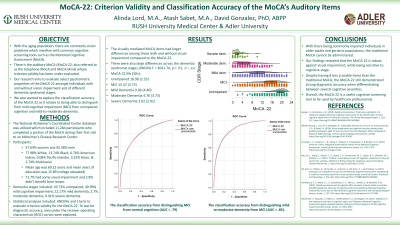
Results: The visually mediated MoCA items had larger differences among those with and without visual impairment compared to the MoCA-22. There were also strong differences across the dementia syndromal stages which carried over to strong classification accuracy in distinguishing MCI from normal cognition (AUC = .79), and mild-to-moderate dementia from MCI (AUC = .85).
Conclusions: These findings add to the evidence of the MoCA-22’s utility for visual impaired individuals who otherwise cannot complete the full version of the MoCA. The MoCA-22 serves as a useful cognitive screening tool in differentiating between cognitive severities.