Graduate Student University of North Carolina Wilmington Wilmington, North Carolina, United States
Objective: The current study aims to assess the relationship among scores on the test of memory malingering (TOMM) and general demographics (age, education, ethnicity, and gender) as well as military-specific variables (Armed Services Vocational Aptitude Battery (ASVAB), number of deployments, and blasts) using a large military sample.
Method: An archival dataset (https://osf.io/rv9cj/), representative of the military personnel according to the Marine Corps Demographics Update (2015) consisting of 875 participants between 18-62 years, predominately male and caucasian was analyzed. Participants were referred by their medical provider for psychological and/or neurological complaints and completed a neuropsychological evaluation comprised of a clinical interview and a neuropsychological blast battery consisting of demographics and 15 tests, including the TOMM. Pre-morbid information was gathered using the ASVAB which has the following subscales: armed forces qualification test, general technical, mechanical maintenance, clerical, and electronics.
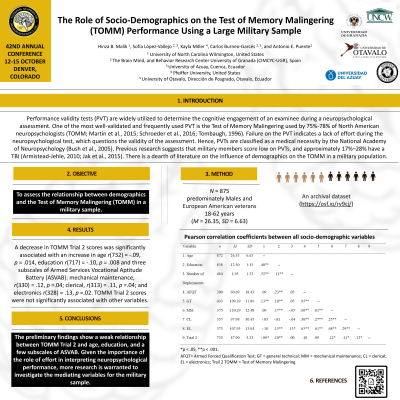
Results: A decrease in TOMM Trial 2 scores was significantly associated with an increase in age r(732) = -.09, p = .014, education r(717) = -.10, p = .008, mechanical maintenance, r(330) = .12, p =.04; clerical, r(313) = .11, p =.04; and electronics r(328) = .13, p =.02. TOMM Trail 2 scores were not significantly associated with other variables.
Conclusions: The findings show a weak relationship between TOMM Trial 2 and age, education, and a few subscales of ASVAB. This suggests that both demographic and vocational abilities appear to be potential mediating variables in understanding the role of effort in interpreting neuropsychological performance.