Doctoral Student Florida Tech Ronkonkoma, New York, United States
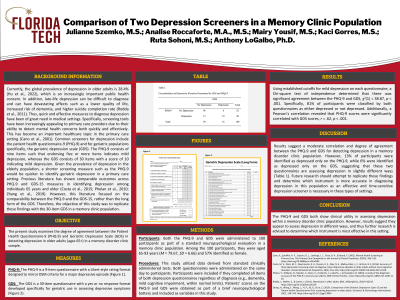
Objective: The present study examines the degree of agreement between the Patient Health Questionnaire-9 (PHQ-9) and Geriatric Depression Scale (GDS) in detecting depression in older adults (ages 65+) in a memory disorder clinic sample.
Method: Data from 100 memory disorder clinic patients, ages 65-93 (M = 79.67, SD = 6.66; 57% female) was utilized. Participants were included if they completed all items of both depression questionnaires regardless of diagnosis (e.g., dementia, mild cognitive impairment, within normal limits). Patients’ scores on the PHQ-9 and GDS were obtained as part of a brief neuropsychological battery and included as variables in this study.
Results: Using established cutoffs for mild depression on each questionnaire, a Chi-square test of independence determined that there was significant agreement between the two, χ2(1) = 38.87, p < .001. Specifically, 81% of participants were classified by both questionnaires as either depressed or not depressed. Additionally, a Pearson’s correlation revealed that PHQ-9 scores were significantly correlated with GDS scores, r = .62, p < .001.
Conclusion: Results suggest a moderate correlation and degree of agreement between the PHQ-9 and GDS for detecting depression in a memory disorder clinic population. However, 13% of participants were identified as depressed only on the PHQ-9, while 6% were identified as depressed only on the GDS, suggesting that these two questionnaires are assessing depression in slightly different ways. Future research should attempt to replicate these findings and determine which instrument is more accurate in diagnosing depression in this population.