Graduate Student Cleveland State University Strongsville, Ohio, United States
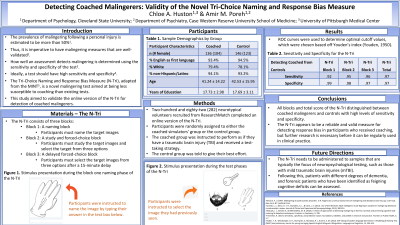
Objective: The prevalence of malingering following a personal injury is estimated to be more than 50% (Resnick, 1997). Thus, it is imperative to have malingering measures that are well-validated (Janaski et al., 2011). Ideally, malingering tests should have high sensitivity and specificity (Trevethan, 2017). The Tri-Choice Naming and Response Bias Measure (N-Tri) is a novel malingering test aimed at being less susceptible to coaching than existing tests. This study aimed to validate the N-Tri for detection of coached malingerers.
Methods: 282 neurotypical participants completed an online version of the N-Tri. The N-Tri consists of three blocks: a naming block, a study and forced-choice block, and a delayed forced-choice block. Participants were randomly assigned to either the coached simulators’ group or the control group. The coached group was instructed to perform as if they have a traumatic brain injury (TBI) and received a test-taking strategy.
Results: ROC curves were used to determine optimal cutoff values, which were chosen based off Youden’s index (Youden, 1950). Block 1 had a sensitivity of 92% and a specificity of 99%. Block 2 had a sensitivity of 95% and a specificity of 98%. Block 3 had a sensitivity of 96% and a specificity of 97%. Total score had a sensitivity of 97% and a specificity of 97%.
Conclusions: This study demonstrated that all blocks and total score of a novel malingering test, the N-Tri, were able to distinguish between coached malingerers and controls with high levels of sensitivity and specificity. Further research that utilizes patients with documented memory deficits are proposed.