Background and objective: Senescent cell is reported as a cause of aging and induce chronic inflammation in various organs. Therefore, controlling chronic inflammation by eliminating senescent cells will lead to the development of comprehensive therapies for periodontal disease and atherosclerosis, which are based on chronic inflammation. In this study, we examined the effects of senescence inhibition by senolytic drugs using old mice for the creation of model animal. Materials and
Methods: Twenty-five 69-week-old wild-type C57BL6 mice and eight 89-week-old ApoE-/- mice, a model of genetic hyperlipidemia, were used. These mice were further divided into two groups: a drug-treated group (12 C57BL6 mice and 3 ApoE-/- mice) and a non-treated group (13 C57BL6 mice and 5 ApoE-/- mice). The drug-treated group received the senolytic drug for 2.5 months. The animals were then euthanized and periodontal tissue and aorta were removed. The periodontal Background and objective: Senescent cells induce chronic inflammation in various organs and are a reported cause of aging. Controlling chronic inflammation by eliminating senescent cells may lead to the development of comprehensive therapies for periodontal disease and atherosclerosis, which are based on chronic inflammation. In this study, we examined the effects of senescence inhibition by senolytic drug treatment in an animal model of aged mice. Materials and
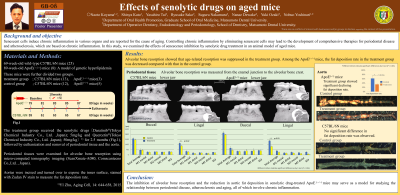
Methods: Twenty-five 69-week-old wild-type C57BL6 mice and eight 89-week-old ApoE−/− mice, a model of genetic hyperlipidemia, were used. These mice were further divided into a treatment group (12 C57BL6 and 3 ApoE−/− mice) and an untreated control group (13 C57BL6 mice and 5 ApoE−/− mice). The treatment group received the senolytic drug for 2.5 months, followed by euthanization and removal of periodontal tissue and the aorta. Periodontal tissues were examined for alveolar bone resorption using micro-computed tomography imaging. Maxillary bones were stained with β-galactosidase, a marker of cellular senescence. Aortas were stained with Zudan IV stain to measure the fat deposition rate.
Results: Between-group comparisons of alveolar bone resorption showed that age-related resorption was suppressed in the treatment group. Among the ApoE−/− mice, the fat deposition rate in the treatment group was decreased compared with that in the control group.
Conclusion: The inhibition of alveolar bone resorption and the reduction in aortic fat deposition in senolytic drug-treated ApoE−/− mice may serve as a model for studying the relationship between periodontal disease, atherosclerosis and aging, all of which involve chronic inflammation.