Vice president Kiwakai Dental Clinic chuo-ku Tokyo, Japan
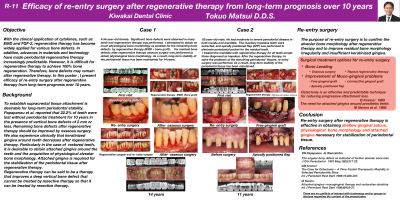
[Background and Objective] With the clinical application of cytokines, such as EMD and FGF-2, regenerative therapy has become widely used for various bone defects. In addition, advances in materials and technology have made periodontal regeneration therapy increasingly predictable. In this article, we discuss the key points of regenerative therapy in patients with periodontal disease based on the long-term results over 10 years. [Cases] (1) A 54-year-old woman presented to our hospital with a chief concernof pain in the right tooth region and inability to bite. The patient was treated with regenerative therapy. However, after the regenerative therapy, there was clinical evidence of hard tissue neoplasia, but slight bone loss. We attempted to obtain as much physiological bone morphology as possible for the remaining bone defect by regenerative bone surgery. (2) A 62-year-old man presented to our hospital with a chief concern of tooth mobility. He had moderate to severe periodontal disease in both upper and lower jaws and bone defects extending to the root apex. The maxillary bicuspids on both sides were extracted, and the anterior teeth were treated with prosthetic therapy after periodontal pocket removal. We decided to treat the mandible with regenerative therapy for all teeth except those diagnosed as hopeless. After the regenerative therapy, to solve the problem of the remaining periodontal tissues, surgical bone reshaping was performed, and the remaining periodontal pockets were removed by free gingival grafting and adequate width of attached gingiva was obtained. [Result] In both cases, shallow periapical gingival sulci, physiological bone morphology, and adequate width of attached gingiva were obtained and remained stable for a long period of time. [Conclusion] The proper protocols of regenerative therapy, including selection of indications, incision, dissection, debridement, and suturing, adhering to basic principles, will lead to a good outcome. In addition, it is important to improve residual problems after regenerative therapy to stabilize the long-term prognosis.