Graduate Student Section of Periodontology, Division of Oral Rehabilitation, Faculty of Dental Science, Kyushu University
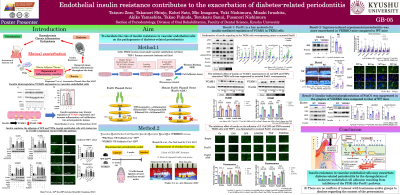
Background and objective: Local insulin resistance is suggested to contribute to the exacerbation of periodontitis under diabetes. However, it remains unclear how periodontal insulin resistance is involved in the pathogenesis of diabetes-related periodontitis. In this study, we investigated the pathogenic role of insulin resistance on vascular endothelial cell function that mediates the recruitment of inflammatory immune cells. Materials and
Methods: Using murine vascular endothelial cell line (TKD2), the inhibitory effect of insulin (100nM) on E.coli LPS and TNFα (10ng/ml, respectively)-induced cell adhesion molecules (CAMs) expression and cellular adhesion with human leukocyte cell line (THP-1) were assessed. Then, potential regulatory signaling pathway of insulin on CAMs expression was investigated. Furthermore, using vascular endothelial cell-specific insulin receptor knockout (KO) mice, 7-0 silk ligature-induced alveolar bone loss and insulin signaling in mice gingiva were compared.
Results: Western blot analyses showed LPS and TNFα-induced VCAM-1 expression was significantly suppressed by insulin pretreatment via the PI3K-Akt-FoxO1 pathway. Subsequently, insulin significantly downregulated cellular adhesion of LPS and TNFα-treated TKD2 with THP-1. High (25mM) glucose treatment for 48 hours significantly inhibited insulin-mediated activation of PI3K-Akt-FoxO1 pathway and abolished its regulatory effect on VCAM1 expression. KO mice showed significantly less insulin action in the gingiva and exacerbated alveolar bone loss compared to WT mice.
Conclusion: These results suggest that insulin resistance in the vascular endothelial cells may promote the recruitment of inflammatory immune cells in the gingiva by disturbing the regulatory effect on VCAM-1 expression by insulin, resulting in the exacerbation of periodontal tissue destruction.