Assistant Professor Division of Periodontology, Department of Oral Biology and Tissue Engineering, Meikai University School of Dentistry
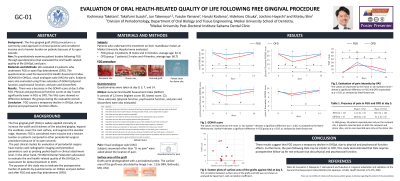
Background and objective: The free gingival graft (FGG) procedure is a commonly used approach in clinical practice for increasing vestibular depth and width of the attached gingiva. FGG is considered more invasive and a heavier burden on patients compared to other periodontal surgical procedures because of its open wounds. The aim of this study was to quantitatively examine patient burden following FGG through questionnaires that evaluated the oral health-related quality of life (OHQoL) and pain. Materials and
Methods: The study evaluated 21 patients who underwent FGG or open flap debridement (OFD) on their mandibular molars. The questionnaires used the General Oral Health Assessment Index (GOHAI) for OHQoL, visual analogue scale (VAS) for pain. Subjects were also evaluated using three subscales of GOHAI (physical function, psychosocial function, and pain and discomfort).
Results: There was a significant decrease in the GOHAI score at day 3 after FGG as compared to baseline. Physical and psychosocial function scores at day 3 were significantly lower in FGG versus OFD. Furthermore, the VAS score increased significantly at day 3 in both groups and no difference between the groups during the evaluation period.
Conclusion: These results suggest that FGG causes a temporary decline in OHQoL due to physical and psychosocial function effects. This study demonstrated that FGG requires postoperative follow-up for not only pain but also physical and psychosocial function.