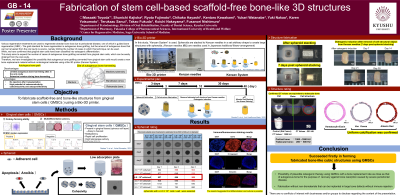
Background and objective: Although periodontal tissue regenerative therapy has been widely used to recover alveolar bone absorbed by periodontal disease, its indications are limited. In this study, we aimed to establish a new strategy to regenerate alveolar bone by creating cellular structures using mesenchymal stem cells with bone differentiation ability by using a bio-3D printer by "Kenzan Method" that can create scaffold-free cellular structures. Materials and
Methods: Cell clusters (spheroids) were prepared from human gingival stem cells (hGMSCs) using cell-low attachment surface 96-well plates. Cluster size measurements were performed and expression of stem cells (CD73) and apoptosis (Cleaved Caspase-3) markers were confirmed by fluorescent immunostaining. After 4 weeks of osteogenic differentiation, frozen sections were prepared for evaluation of calcification by Alizarin Red and Von Kossa staining. μCT analysis was also performed to measure the bone mineral density (BMD).
Results: 4.0×10^4 cells/well were seeded, and spheroid with a diameter of 500-600 μm was successfully created to enable structure formation. Immunofluorescent staining revealed the expressions of stem cell markers, and a small amount of apoptosis markers without affecting the growth of spheroid were observed. Four weeks after osteogenic differentiation, calcification of the bio-3D printed spheroids was confirmed by Alizarin Red staining and Von Cossa staining. μCT analysis further revealed that the BMD of the calcified structure was almost identical to that of trabecular bone.
Conclusion: Using a bio-3D printer, scaffold-free bone-like structures were successfully fabricated from gingival-derived stem cells.