graduate student Kyushu University, Fukuoka, Japan
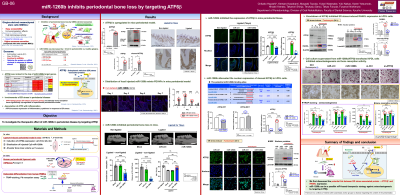
Background and objective: We recently demonstrated that TNF-α stimulation enhanced the expression of miR-1260b in human gingival MSCs (hGMSCs)-derived exosomes and these exosomes successfully inhibited periodontal bone loss in mice model (Nakao Y, et al., Acta Biomater, 2022). It is also reported that ER stress-related genes are up-regulated in periodontal lesion (Yamada H, et al. J Periodontal Res., 2002), and database analysis suggested that miR-1260b could be a possible regulator of ER stress by targeting ATF6β. In this study, we, therefore, investigated the therapeutic effect of miR-1260b in periodontal lesion by targeting ATF6β Materials and
Methods: Human periodontal ligament cells (hPDLCs) were transfected with miR-1260b to confirm the inhibition of ATF6. The effect of miR-1260b on inflammatory bone loss were validated in mouse ligature-induced periodontitis model (Kyushu University, #A21-131-2). The expression of ATF6β in mice gingiva was observed by immunohistochemistry and periodontal bone loss was evaluated byCT analysis. PBMCs and RAW-D cells were cultured with supernatants of hPDLCs transfected by ATF6β siRNA and the number of TRAP positive cells were counted.
Results: Transfection of miR-1260b mimic inhibited ATF6β expression and knock-down of ATF6βdecreased the expression of RANKL in hPDLCs. Increased expression of ATF6β was observed in the ligated periodontal lesion, and the local injection of miR-1260b mimic decreased periodontal bone resorption in mice model. Supernatants of hPDLCs transfected by ATF6β siRNA inhibited osteoclast formation.
Conclusion: miR-1260b inhibited periodontal bone loss by targeting ER stress. Thus, miR-1260b therapy can be a novel strategy against periodontal bone loss.