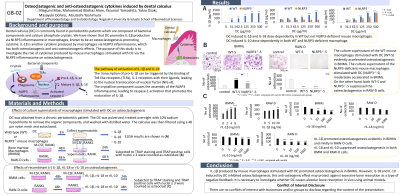
Background and objective: Dental calculus (DC) is frequently found in periodontitis patients and composed of bacterial components and calcium phosphate crystals. We have shown that the crystal components of DC promote IL-1β production via NLRP3 inflammasome in macrophages. Because IL-1β is known to promote osteoclastogenesis, we investigated the effects of cytokines produced by mouse macrophages stimulated with DC on osteoclastogenesis. Materials and
Methods: DC from periodontitis patients was pulverized, treated with 10% sodium hypochlorite, and extensively washed with distilled water. Wild-type (WT) and NLRP3-deficient mouse macrophages were stimulated with DC and the culture supernatants were harvested. M-CSF and RANKL-primed mouse bone marrow-derived macrophages (BMMs) and RAW-D cells were incubated with these supernatants. Following TRAP staining, the number of multinuclear TRAP positive cells was counted. The concentrations of IL-1β, IL-18, and IL-10 in the culture supernatants were measured by ELISA. To analyze the effects of these cytokines, osteoclasts were generated from BMMs and RAW-D cells in the presence or absence of recombinant (r)IL-1β, IL-18, or IL-10.
Results: The culture supernatant from WT mouse macrophages promoted osteoclastogenesis of BMMs but inhibited that of RAW-D cells. WT mouse macrophages stimulated with DC produced IL-1β, IL-18, and IL-10 dose-dependently whereas NLRP3-deficient mouse macrophages produced IL-10, but not IL-1β and IL-18, in response to DC. rIL-1β promoted osteoclastogenesis of RANKL-primed BMMs and RAW-D cells, but rIL-18 and rIL-10 inhibited their osteoclastogenesis.
Conclusion: DC may promote alveolar bone resorption via IL-1β induction in periodontitis patients, but suppress resorption via IL-18 and IL-10 induction in some circumstances.


.jpg "Megumi Mae, PhD (she/her/hers) photo")