graduate Nihon University School of Dentistry yokohama, Kanagawa, Japan
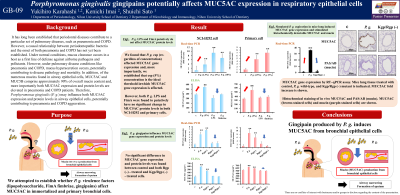
Background and objective: It has long been established that periodontal diseases contribute to a particular set of pulmonary diseases, such as pneumonia and COPD. However, a causal relationship between periodontopathic bacteria and the onset of pneumonia and COPD has not yet been established. Under normal conditions, mucus clearance occurs in a host as a first line of defense against airborne pathogens and pollutants, however, under pulmonary disease conditions like pneumonia and COPD, mucus hypersecretion occurs, potentially contributing to disease pathology and mortality. In addition, of the numerous mucins found in airway epithelial cells, MUC5AC and MUC5B comprise approximately 90% of overall mucin content and more importantly, MUC5AC expression and protein levels are elevated in pneumonia and COPD patients. Therefore, Porphyromonas gingivalis (P.g.) may influence both MUC5AC expression and protein levels in airway epithelial cells, potentially contributing to the aggravation of pneumonia and COPD. Here, the remit of this study was to establish whether P.g. virulence factors affected MUC5AC in immortalized and primary bronchial cells.
Results: MUC5AC gene expression and protein levels are affected by P.g. culture supernatant, but not by lipopolysaccharide or FimA fimbriae. Cells treated with either P.g. single (Kgp or Rgp) or double (Kgp/Rgp) mutants had altered levels of MUC5AC gene expression and protein levels, and MUC5AC staining of double mutant-treated mouse lung cells showed that MUC5AC protein levels were unaffected.
Conclusion: P.g. gingipains may be the primary virulence factor that influences both MUC5AC gene expression and protein levels, potentially contributing to pneumonia and COPD aggravation.