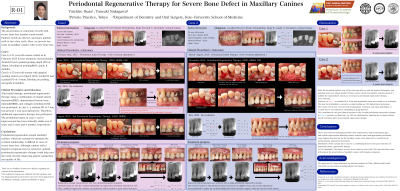
Background: There remains controversy about whether teeth involved with severe bone loss should be saved or extracted. Patients’ needs are diverse, but many patients wish to save their teeth. Here we present two cases in which maxillary canines accompanied by severe bone defects.
Case: Case1) A 51-year-old female visited in February 2015. Her chief complaint was to treat periodontitis. #23 had a probing depth (PD) of 10mm at the palatal site and the presence of bleeding. Tooth mobility was grade Ⅱ. Case2) A 55-year-old female visited in March 2019. Her chief complaint was gingival swelling. #23 had an over 10mm PD at the palatal site and the presence of bleeding. Tooth mobility was grade Ⅱ. Clinical Procedures and Outcomes: After initial therapy, periodontal regeneration using a combination of enamel matrix derivative, deproteinized bovine bone mineral, and collagen membrane was performed. Five mm of PD and the presence of bleeding remained at a re-evaluation 1 year after surgery in case 1, thus additional regenerative therapy was performed. Periodontal tissues in both cases 1 and 2 improved and have been clinically stable for 6 years, and 2 years and 6 months post-surgery, respectively.
Conclusion: The maxillary canine, which has significant role in occlusal relations, seemed to be difficult to achieve periodontal regeneration since there is a severe bone defect. Although it might be one option to extract a hopeless canine, optimal periodontal regenerative therapy could achieve saving the teeth, which led to higher patient satisfaction and the improvement of QOL.