Senior Assistant Professor Department of Periodontology, Tokyo Dental College, Tokyo, Japan
Background: In Japan, fibroblast growth factor-2 (FGF-2) has been clinically used as a periodontal regenerative therapy. We report a 3-year follow-up of a patient with chronic periodontitis who received regenerative therapy using FGF-2.
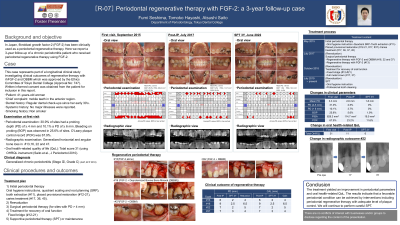
Case: The patient was a 41-year-old woman who complained of mobile teeth in the anterior region. Initial examination revealed 30.9% of sites with a probing depth (PD) of > 4 mm, full-mouth mean PD was 3.3 mm. The O’Leary plaque control record was 67.9%. Radiographic examination revealed angular bone resorption in #13,16,22,47. A clinical diagnosis of generalized chronic periodontitis (Stage III, Grade C) was made. Clinical Procedures and Outcomes: The patient underwent initial periodontal therapy including plaque control, scaling and root planing. After reevaluation, a series of surgical interventions were performed in #13,16,22,47. Regenerative therapy using FGF-2 (Regroth) was performed on the narrow intrabony defect of #13, and the combination therapy using FGF-2 and deproteinized bovine bone mineral (Bio-Oss) was performed on the wide and deep intrabony defects of #16,22,47. Following reevaluation, then the patient was placed on supportive periodontal therapy. At 3 years postoperatively, #13 yielded clinical attachment level (CAL) gains of 4.0 mm and #16,22,47 yielded CAL gains of 5.2 ± 1.0 mm, respectively. Distinct radiographic bone fill was observed following the treatment with FGF-2. No sites showed PD of > 4 mm, and the mean full-mouth PD was reduced to 2.2 mm.
Conclusion: At 3 years postoperatively, the regenerative therapy using FGF-2 yielded improvements in clinical parameters and radiographic bone fill.


.jpg "Fumi Seshima, PhD photo")