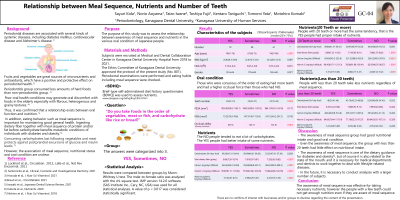
Background and objective: Oral diseases are strongly linked with systemic disorders. Eating behavior such as meal sequence is important for maintaining good general health. Poor oral condition could cause malnutrition, however, the effect of oral condition on food intake has not been clarified. The purpose of this study was to assess the relationship between awareness of meal sequence and nutrients in the various oral condition of Japanese people. Materials and
Methods: The subjects were recruited at the Medical and Dental Collaboration Center in Kanagawa Dental University Hospital from 2018 to 2021. Clinical examinations such as body composition analysis, periodontal measurement, and assessment of chewing ability were performed and data of meal sequence was collected. Brief-type self-administrated diet history questionnaire (BDHQ) was used to assess nutrients. The Ethics Committee of Kanagawa Dental University approved the protocol of the present study (No. 801).
Results: 238participants with mean age of 67.5 were enrolled in this study. 79 people had an eating behavior, in which they take meal sequence of vegetables, meat or fish and carbohydrate. On the other hand, 61people had completely no awareness of the meal sequence. People who had the awareness of the meal sequence obtained proper nutrients in dietary fiber, calcium, and vitamin C compared with those who had no awareness. While people with many teeth obtained sufficient nutrients according to the awareness of food intake, people with less than 20 teeth obtained inadequate nutrients even if they had the awareness of meal sequence.
Conclusion: People with a few teeth could not get enough nutrition even if they are aware of meal sequence.