Graduate student Meikai university Kawagoe-shi, Saitama, Japan
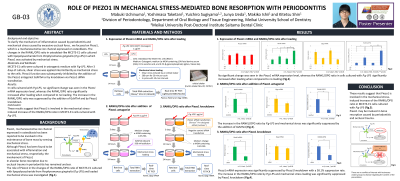
Background and objective: Excessive occlusal force with periodontitis results in rapid alveolar bone resorption. However, the molecular mechanism underlying the interaction between inflammation and mechanical stress has yet to be completely elucidated. To clarify the mechanism, we focused on Piezo1, which is a mechanosensitive ion channel expressed on osteoblasts. The changes in the RANKL/OPG ratio in osteoblast-like MC3T3-E1 cells cultured with lipopolysaccharide from Porphyromonas gingivalis (P.g-LPS) in which Piezo1 was activated by mechanical stress. Materials and
Methods: MC3T3-E1 cells were cultured in osteogenic medium with P.g-LPS. After 3 days of culture, shear stress induced by an orbital shaker was applied intermittently as mechanical stress to the cells at 200 rpm for 20 min per cycle. The stress was loaded for five cycles at 10-min intervals. Piezo1 function was subsequently inhibited by the addition of the Piezo1 antagonist GsMTx4 or by knockdown via Piezo1 siRNA transfection. After loading, total RNA was isolated from the cells, and real-time PCR was performed to assess the mRNA expression levels of Piezo1, RANKL, and OPG.
Results: In cells cultured with P.g-LPS, no significant change was seen in the Piezo1 mRNA expression level, whereas the RANKL/OPG ratio significantly increased after loading when compared to no loading. The increase in the RANKL/OPG ratio was suppressed by the addition of GsMTx4 and by Piezo1 knockdown.
Conclusion: These results suggest that Piezo1 is involved in the mechanical stress-induced increase of the RANKL/OPG ratio in MC3T3-E1 cells cultured with P.g-LPS.