Post-doctoral fellow Health Sciences University of Hokkaido Ishikari Tobetsu, Hokkaido, Japan
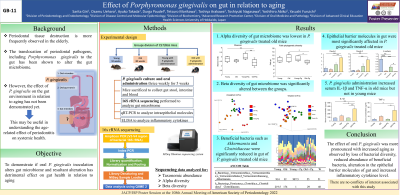
[Background and objective] Periodontal tissue destruction is more frequently observed in the elderly. The translocation of periodontal pathogens, including P. gingivalis to the gut has been shown to alter the gut microbiome. However, the effect of P. gingivalis on the gut environment in relation to aging has not been demonstrated. We hypothesize that P. gingivalis has a more detrimental effect on the gut environment with increased age. [Materials and Methods] C57BL/6J mice aged 4 weeks (young) or 76 weeks (old) were divided into four groups: control-young, control-old, P. gingivalis-administered young, and P. gingivalis-administered old. The P. gingivalis group were orally administered with P. gingivalis thrice weekly for 5 weeks. After 30 days of the last P. gingivalis administration, the gut microbiome was studied using 16S rRNA sequencing. The mRNA expression of intestinal junctional barrier molecules and the levels of the inflammatory cytokines IL-1β and TNF-α in the serum was evaluated. [Result] Significant differences in the gut microbiomes between the groups, in terms of taxonomic abundance, bacterial diversity, and predicted metagenome function was observed. A significant reduction in the alpha diversity and in the abundance of beneficial bacteria, such as Akkermensia and Clostrodiaceae, in the P. gingivalis-administered old mice was observed. The mRNA levels of Claudin-1 and Claudin-2 in the intestine were significantly elevated in P. gingivalis-administered old mice, as were the serum levels of IL-1β and TNF-α. [Conclusion] The effect of P. gingivalis on the gut environment is more pronounced in old mice than in young mice.