2102: Does Remission According Definition of Remission in SLE (DORIS) 2021 Match the Treating Rheumatologist Judgment? Analysis at Recruitment of a Prospective Study of 500 SLE Patients from a Spanish Multicenter Cohort
Irene Altabas Gonzalez1, Coral Mouriño Rodriguez1, Iñigo Rúa-Figueroa2, Francisco Rubiño3, Iñigo Hernandez Rodriguez1, Raul Menor Almagro4, Esther Uriarte Isacelaya5, Eva Tomero Muriel6, Tarek Carlos Salman-Monte7, Irene Carrion Barbera8, maria Galindo9, Esther Rodriguez Almaraz9, Norman Jimenez10, Luis Ines Sousa11 and Jose M Pego-Reigosa12, 1Complejo Hospitalario Universitario de Vigo, Vigo, Spain, 2Hospital Universitario Dr Negrín, Las Palmas de Gran Canaria, Spain, 3Hospital Universitario de Jerez de la Frontera, Jerez de la frontera, Spain, 4Hospital Jerez de la Frontera, Cádiz, Spain, 5Hospital Universitario Donostia, Donostia, Spain, 6Hospital Universitario La Princesa, Madrid, Spain, 7Hospital del Mar/Parc de Salut Mar-IMIM/UEC-AIS, Barcelona, Spain, 8Hospital del Mar, Rheumatology, Barcelona, Spain, 9Hospital Universitario 12 de Octubre, Madrid, Spain, 10IRIDIS Group, Vigo, Spain, 11Centro Hospitalar e Universitario de Coimbra, Coimbra, Portugal, 12Hospital Meixoeiro, Vigo, Spain
Background/Purpose: An accurate target in Systemic Lupus Erythematosus (SLE) Treat to Target strategies has been challenging over the past years. Recently, a new definition of remission was updated in 2021 by the international DORIS (Definition of Remission in SLE) taskforce.
To quantify the proportion of patients who achieve DORIS and evaluate the agreement between DORIS and the treating rheumatologist judgement.
Methods: Prospective multicenter study of SLE patients (ACR 1997 Classification Criteria or Clinical diagnosis by the Physician) from seven Spanish Rheumatology Departments. DORIS remission definitions were applied and the rheumatologists were asked to classified the activity of the disease in 5 different categories (remission, clinical quiescent, low, moderate or high activity). Statistical analysis: descriptive cross-sectional (at the time of recruitment) analysis was done. Analysis of the level of agreement between expert opinion and the definition of remission was evaluated using Cohen's kappa. The reasons of disagreement were evaluated.
Results: A total of 508 patients were included (92% women; mean age (±SD): 50.4 years (±SD 13.7)). Table 1 shows in detail the patients characteristics at baseline. Two hundred and sixty-seven (54.4%) patients were in DORIS remission; while, according to the rheumatologist judgement, 206 (41.6%) patients were considered in remission and 71 (14.3%) in a clinical quiescent state (Figure 1). Overall agreement between rheumatologist opinion and DORIS was 81.28% (95% CI: 79.9, 82.9) with a Cohen's kappa of 0.62. We found disagreement in 46 patients, and the main reasons were a clinical SLEDAI >0 in 39 (84.8%) patients; Physician Global Assessment (PGA) >0.5 in 5 patients and a prednisone dose above 5 mg day in other five patients.
Conclusion: At a given point in time, more than half of SLE patients were in DORIS remission. The overall agreement between rheumatologist opinion and DORIS remission is very accurate. Concordance of DORIS and physician remission.
Patient demographics and disease characteristics. Disclosures: I. Altabas Gonzalez, None; C. Mouriño Rodriguez, None; I. Rúa-Figueroa, None; F. Rubiño, None; I. Hernandez Rodriguez, None; R. Menor Almagro, None; E. Uriarte Isacelaya, None; E. Tomero Muriel, None; T. Salman-Monte, GlaxoSmithKlein(GSK); I. Carrion Barbera, None; m. Galindo, None; E. Rodriguez Almaraz, None; N. Jimenez, None; L. Sousa, None; J. Pego-Reigosa, None.

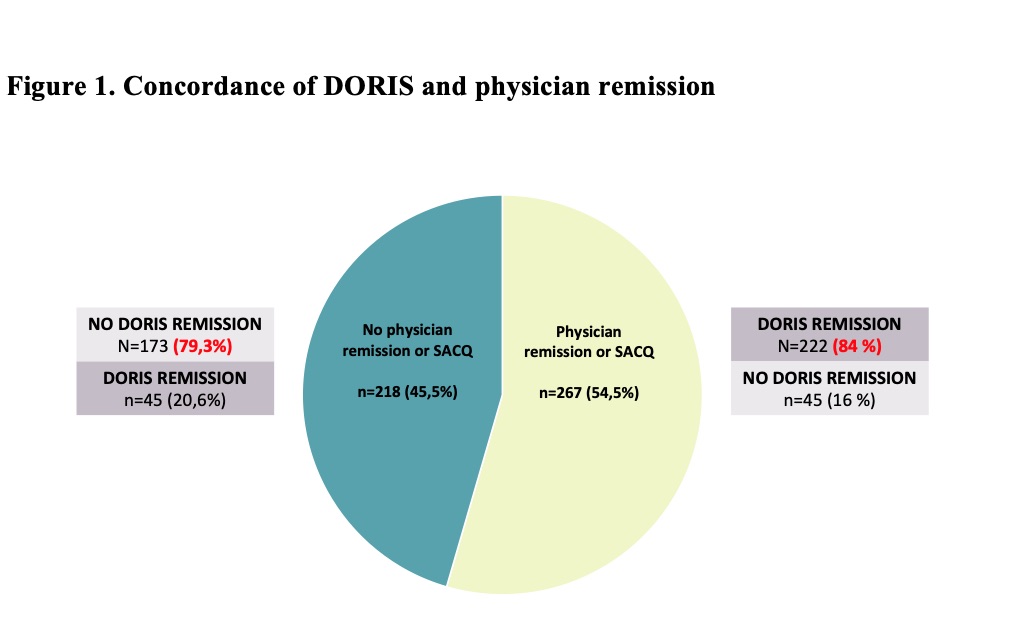 Concordance of DORIS and physician remission.
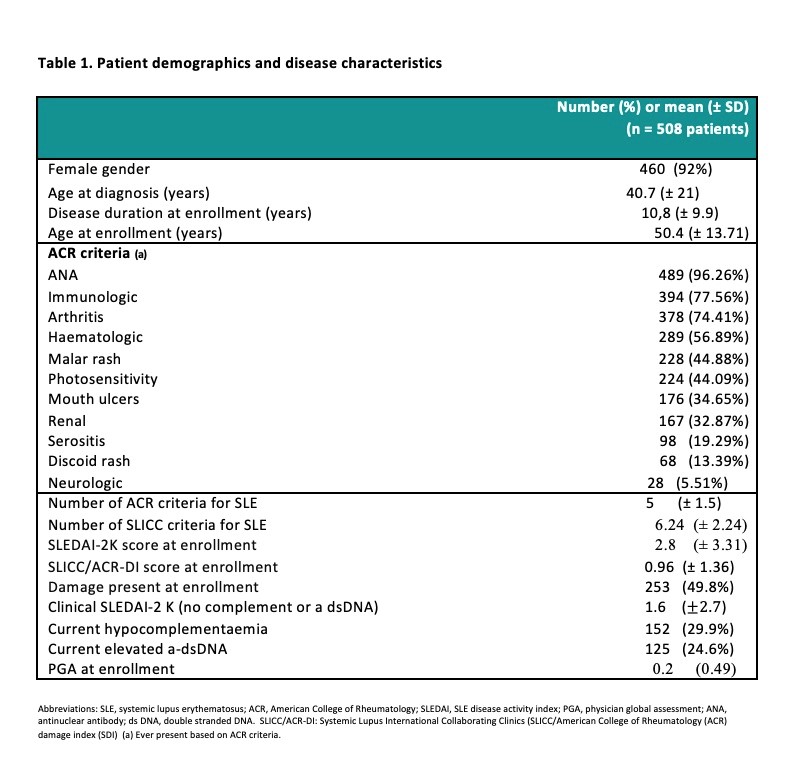 Patient demographics and disease characteristics.