Session: (1830–1855) Miscellaneous Rheumatic and Inflammatory Diseases Poster III
1847: Differences in Key Patient-reported Outcome Domains Identified by the Patient Acceptable Symptom State in the Adult SAPHO and Chronic Nonbacterial Osteomyelitis Observational Study (The SAPHO-CNO Study)
Aleksander Lenert1, Robyn Domsic2, Karmela Kim Chan3, Melissa Oliver4, Jisna Paul5, Courtney Kremer6, Emma Leisinger1, Svjetlana Dolovcak7, Sandy D. Hong8, Aruni Jayatilleke9, Petar Lenert7, T. Shawn Sato1, Samir Shah10, Shima Yasin11, Yongdong (Dan) Zhao12, Daniel Solomon13, Jonathan Templin1 and Polly Ferguson11, 1University of Iowa, Iowa City, IA, 2University of Pittsburgh, Pittsburgh, PA, 3Hospital for Special Surgery, New York, NY, 4Indiana University School of Medicine, Indianapolis, IN, 5Ohio State University Hospital, Dublin, OH, 6University of Iowa Stead Family Children's Hospital, Solna, IA, 7University of Iowa Hospitals and Clinics, Iowa City, IA, 8University of Iowa Stead Family Children's Hospital, Iowa City, IA, 9Temple University, PHILADELPHIA, PA, 10Tufts Medical Center, Boston, MA, 11University of Iowa Carver College of Medicine, Iowa City, IA, 12University of Washington, Redmond, WA, 13Brigham and Women's Hospital, Boston, MA
Background/Purpose: Incorporating patient perspectives of their disease state is needed for disease activity assessment in adults with SAPHO syndrome and chronic nonbacterial osteomyelitis (CNO). The Patient Acceptable Symptom State (PASS), defined as the minimum symptom score beyond which patients consider themselves to be well, can be used to determine symptom control from the patient's perspective. We aimed to evaluate the PASS and its association with key QOL domains in the SAPHO-CNO Study.
Methods: Adults (≥18 years of age) with SAPHO-CNO enrolled in the SAPHO-CNO Study (SCS), a prospective longitudinal observational study, were asked the following PASS question at baseline: "Think about all the ways that your SAPHO/CNO has affected you during the last week. If you were to remain for the next few months as you were in the last week, would this be acceptable to you?". Subjects provided a dichotomous response: acceptable (PASS+) or unacceptable (PASS-). Additionally, we collected validated legacy PRO measurement (PROM) scales and instruments including patient global assessments for SAPHO-CNO disease activity, pain, function and fatigue (0-10 numeric rating scale, NRS), modified Health Assessment Questionnaire (MHAQ, 0-3 scale), 36-item Short Form survey (SF-36), and Patient-Reported Outcomes Measurement Information System (PROMIS) short form (SF) instruments. Descriptive statistics, based on variable distribution curves, were used to summarize the findings. For the comparative analysis (PASS+ vs. PASS-), normally distributed variables were compared with the t-test, while non-normally distributed variables were compared with the Mann-Whitney U-test.
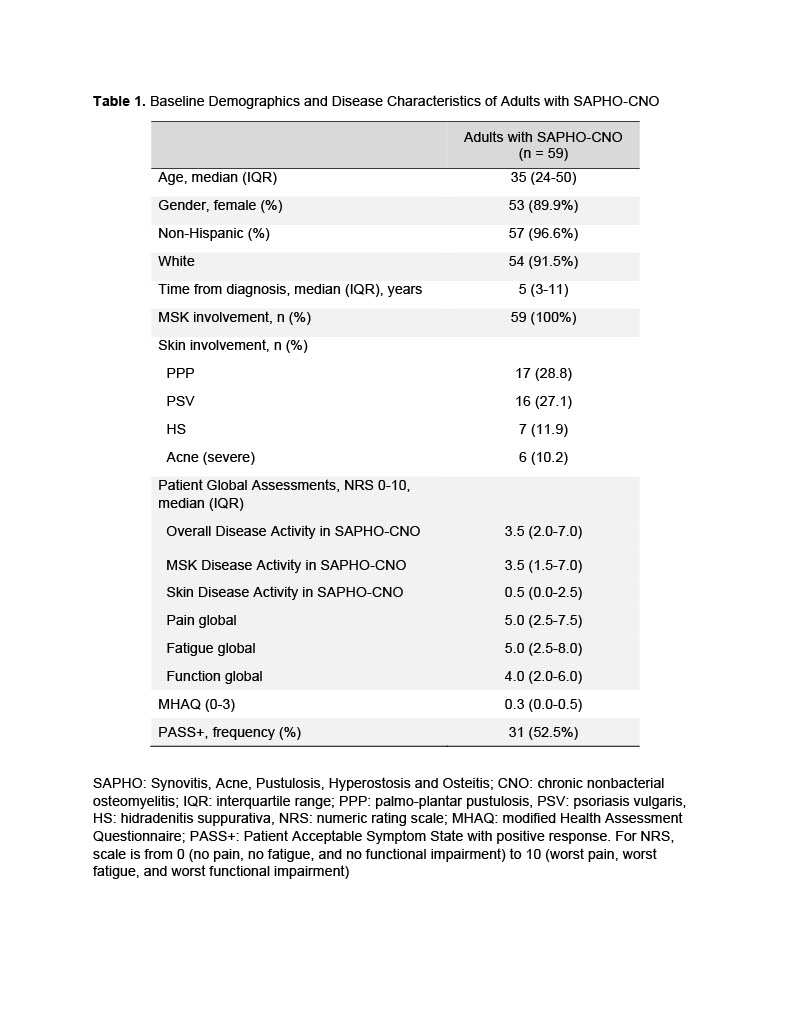
Results: Fifty-nine enrolled subjects completed their baseline study visit and were included in this cross-sectional analysis. Baseline characteristics of the adult SAPHO-CNO cohort are summarized in Table 1. Subjects were predominantly female (89.9%) and Caucasian (91.5%) with a median disease duration of 5 years (IQR, 3-11). All subjects reported MSK involvement, with palmo-plantar pustulosis as the most prevalent skin symptom. Patient global SAPHO-CNO disease activity scores were moderately high, as were patient global scores for pain, fatigue and functional impairment. Overall, 52.5% of subjects in the cohort were in PASS+.
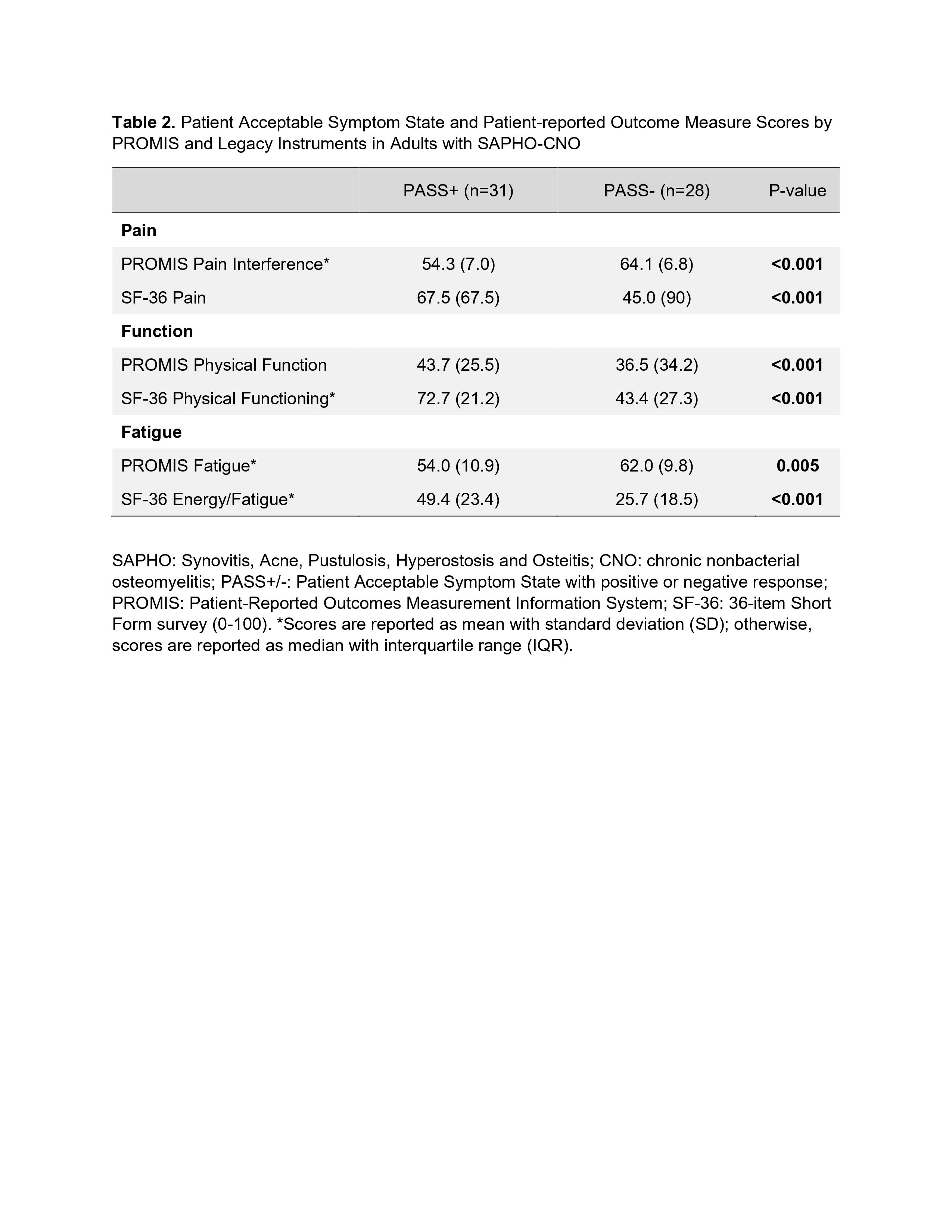
Compared with PASS- subjects, scores for pain, function and fatigue domains, measured by legacy PROM and PROMIS instruments, were all significantly better for the subjects in PASS+ (p< 0.05) (Table 2). Adults with SAPHO-CNO who were PASS- reported high scores, 1.2 or greater standard deviations (SD), for both PROMIS pain interference and fatigue domains, and lower scores, ~ 1.3 SDs, for PROMIS physical function, compared with standardized scores for the general population (mean T-score 50, SD 10). Similar to PROMIS scores, SF-36 domain scores showed corollary findings for pain, fatigue and function for PASS+ subjects (Table 2).
Conclusion: Adult SAPHO-CNO patients who are PASS+ report less pain, fatigue and functional impairment compared with patients who are PASS- in the SAPHO-CNO Study. A multimodal treatment approach for PASS- patients targeting key QOL domains may lead to improved patient outcomes.
Disclosures: A. Lenert, None; R. Domsic, None; K. Chan, None; M. Oliver, None; J. Paul, None; C. Kremer, None; E. Leisinger, None; S. Dolovcak, None; S. Hong, None; A. Jayatilleke, None; P. Lenert, None; T. Sato, None; S. Shah, None; S. Yasin, None; Y. Zhao, None; D. Solomon, AbbVie/Abbott, Amgen, moderna, CorEvitas; J. Templin, None; P. Ferguson, None.