Joanne Nitithalm1, Olivia Solomon2, Laura Trupin3, Patricia Katz4, Jinoos Yazdany4, Maria Dall'Era5, Lisa F Barcellos2, Lindsey Criswell6 and Cristina M Lanata7, 1NIH/NHGRI, Bethesda, MD, 2University of California, Berkeley, Berkeley, CA, 3UC San Francisco, San Francisco, CA, 4UCSF, San Rafael, CA, 5University of California, Division of Rheumatology, San Francisco, CA, 6National Human Genome Research Institute, NIH, Bethesda, MD, 7NIH/NHGRI, Washington, DC
Background/Purpose: Epigenetic clocks based on DNA methylation in blood have been shown to correlate with biological aging and predict adverse health outcomes, including mortality. Accelerated aging based on the epigenetic clock is defined as having a higher predicted biological age than chronological age. The aim of this study is to determine whether SLE patients have accelerated aging compared to healthy controls.
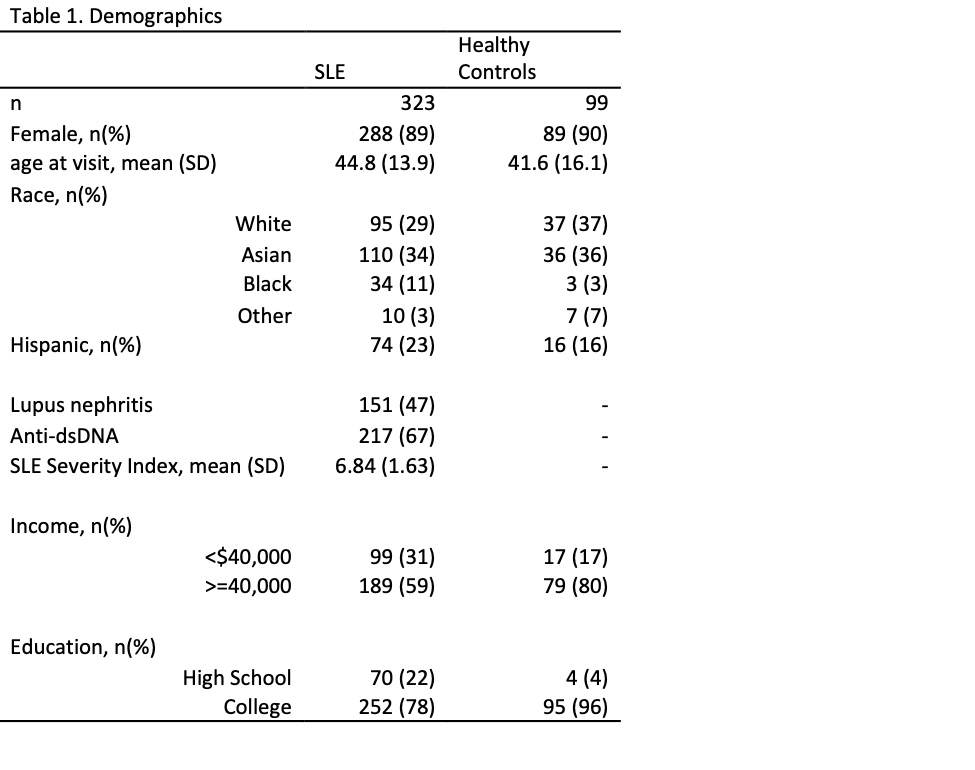
Methods: DNA methylation data were generated using the Illumina Infinium Human MethylationEPIC BeadChip from whole blood samples in a multi-ethnic cohort of 323 SLE cases and 99 healthy controls. Background correction with dye-bias normalization using the preprocessNoob function in the minfi R package was performed on the methylation data. The methylClock R package was used to estimate the biological age using the DNAm Pheno Age clock. The DNAm Pheno Age uses 513 CpGs to estimate the biological age. To test for association with age acceleration in SLE patients versus controls, DNAm Pheno Age was regressed on chronological age, SLE, female, batch and race/ethnicity. Separate models were also run for association testing of income and education. DNAm Pheno Age was regressed on chronological age, income or education, female, batch and race/ethnicity. Additionally, among SLE patients only, association testing was run in separate models for anti-DsDNA status, presence of lupus nephritis and the SLE severity index by adjusting for chronological age, female, batch and race/ethnicity.
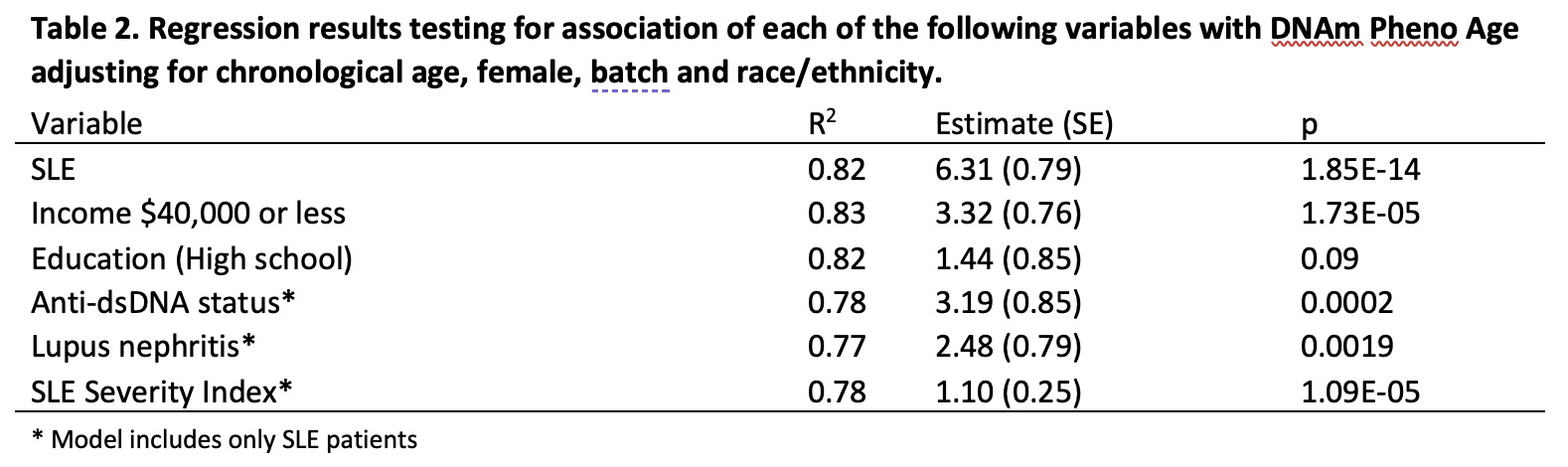
Results: Accelerated aging was associated with SLE status (βSLE=6.3, p=1.85E-14), adjusting for chronological age, sex race/ethnicity and batch. Among SLE patients, accelerated age was associated with anti-dsDNA status (βanti-dsDNA=3.19, p=0.0002), lupus nephritis (βLN=2.48, p=0.0019) and SLE severity index (βsevere=1.10, p=1.09E-05). Accelerated aging was associated with income less than $40,000 (βincome=3.32, p=1.73E-05) but association with education level at high school approached significance.
Conclusion: SLE is associated with accelerated age using DNAm Pheno Age to estimate biological age. Among SLE cases, an association is observed between accelerated age and presence of lupus nephritis, anti-dsDNA positivity, and SLE severity. Sociodemographic factors such as poverty can also influence accelerated aging.
Disclosures: J. Nitithalm, None; O. Solomon, None; L. Trupin, None; P. Katz, None; J. Yazdany, AstraZeneca, AstraZeneca, Bristol-Myers Squibb(BMS), Gilead, Pfizer, Aurinia; M. Dall'Era, GlaxoSmithKline (GSK), AstraZeneca, Aurinia, BMS, Amgen; L. Barcellos, None; L. Criswell, None; C. M Lanata, None.