
.png)
Other


Megan Tufteland, DMD
Chief Resident
University of Nevada, Las Vegas, NV
University of Nevada, Las Vegas School of Dental Medicine
Las Vegas, Nevada, United States
Allison Jae Lenon, BA
University of Nevada, Las Vegas, NV
Spencer Carlile, BA
University of Nevada, Las Vegas, NV
Karl Kingsley, PhD, MPH
UNLV
Las Vegas, Nevada, United States
Megan Tufteland, DMD
Chief Resident
University of Nevada, Las Vegas, NV
University of Nevada, Las Vegas School of Dental Medicine
Las Vegas, Nevada, United States
William Buhler, DDS
University of Nevada, Las Vegas, NV
Las Vegas, Nevada, United States
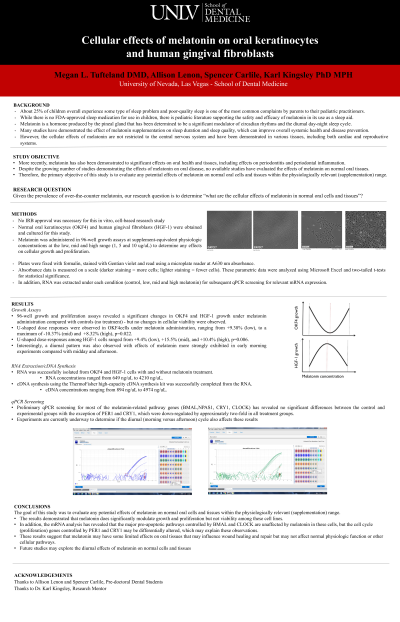
Purpose: Despite the growing number of studies demonstrating the effects of melatonin to improve disordered sleep, no available studies have evaluated the effects of melatonin on normal oral tissues. Therefore, the primary objective of this study is to evaluate any potential effects of melatonin on normal oral cells and tissues within the physiologically relevant (supplementation) range.
Methods: Normal oral keratinocytes (OKF4) and human gingival fibroblasts (HGF-1) were obtained and cultured for this study. Melatonin was administered in 96-well growth assays at supplement-equivalent physiologic concentrations at the low, mid, and high range (1, 5, and 10 ug/uL) to determine any effects on cellular growth and proliferation.
Results: U-shaped dose responses were observed in OKF4 cells under melatonin administration, ranging from +9% (low), to a maximum of -10% (mid) and +8% (high), P=.022. Dose-responses among HGF-1 cells ranged from +9% (low), +16% (mid), and +10% (high), P=.006. Interestingly, a diurnal pattern was also observed with effects of melatonin more strongly exhibited in early morning experiments compared with midday and afternoon. However, viability was not significantly altered in either cell line (range 76-81%). RNA was extracted and qPCR screening for melatonin-related pathway genes (BMAL,NPAS1, CRY1, CLOCK) is on-going.
Conclusions: This study demonstrated that melatonin does affect growth but not viability among these cell lines, which was dose dependent. These results suggest that melatonin may have some limited effects on oral tissues that may influence wound healing and repair but may not affect normal physiologic function or other cellular pathways.