
.png)
Other

Juhyun Cha, DDS
Resident
Department of Oral Medicine, Seoul National University Dental Hospital
Seoul, Seoul-t'ukpyolsi, Republic of Korea
Jee Hee Jang, DDS, MSD
Clinical Assistant Professor
Department of Oral Medicine, Seoul National University Dental Hospital
Seoul, Seoul-t'ukpyolsi, Republic of Korea
Jung Hwan Jo, DDS, PhD
Seoul National University Dental Hospital
Ji Woon Park, DDS, PhD
Seoul National University Dental Hospital
Jin Woo Chung, DDS, PhD
Professor and Chairman
Department of Oral Medicine, Seoul National University Dental Hospital
Seoul, Seoul-t'ukpyolsi, Republic of Korea
Jee Hee Jang, DDS, MSD
Clinical Assistant Professor
Department of Oral Medicine, Seoul National University Dental Hospital
Seoul, Seoul-t'ukpyolsi, Republic of Korea
Jin Woo Chung, DDS, PhD
Professor and Chairman
Department of Oral Medicine, Seoul National University Dental Hospital
Seoul, Seoul-t'ukpyolsi, Republic of Korea
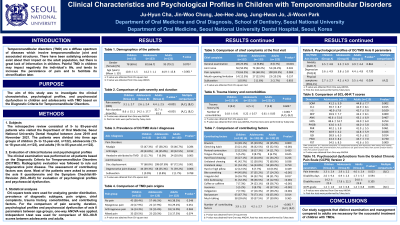
Purpose: There have been great lack of information about the impact of temporomandibular disorders (TMD) on children. The aim of this study was to investigate clinical characteristics, psychological profiles, and psychosocial dysfunction in children and adolescents with TMD.
Methods: Three hundred fifty-five patients with TMD were divided into children (5 to 12 years, n=112), adolescents (13 to 18 years, n=123), and adults (19 to 85 years, n=122) groups. Each group was evaluated clinical characteristics and prevalence of TMD subtypes, and analyzed psychological profiles and psychosocial dysfunction using Diagnostic Criteria for Temporomandibular Disorders (DC/TMD).
Results: Children were brought to the clinic more often only for examination purposes while adults visited the clinic more often due to pain. Pain severity and duration were significantly lower and shorter in children or adolescents than adults. There were no significant differences among three groups in the prevalence of pain disorders (myalgia, arthralgia), but children showed lowest prevalence of joint disorders (disc displacement, degenerative joint disease). Children and adolescents showed significant higher number of bruxism, biting, chin buttressing, and bad posture than adults, while adults reported significant higher number of clenching, unilateral chewing, irregular diet, caffeine intake, insomnia, and weather factor influences. There were no significant differences in anxiety and depression scores among three groups, while children showed significant lower somatization score than adults. Adults showed significant higher Graded Chronic Pain Scale than adolescents.
Conclusion: Our study suggests that distinct examination and management compared to adults are necessary for the successful treatment of children with TMD.